 Technology
 Human Security
 Operational Control Center
 Mobile Security
 Integrated Technical Management
 Training
 Consultancy

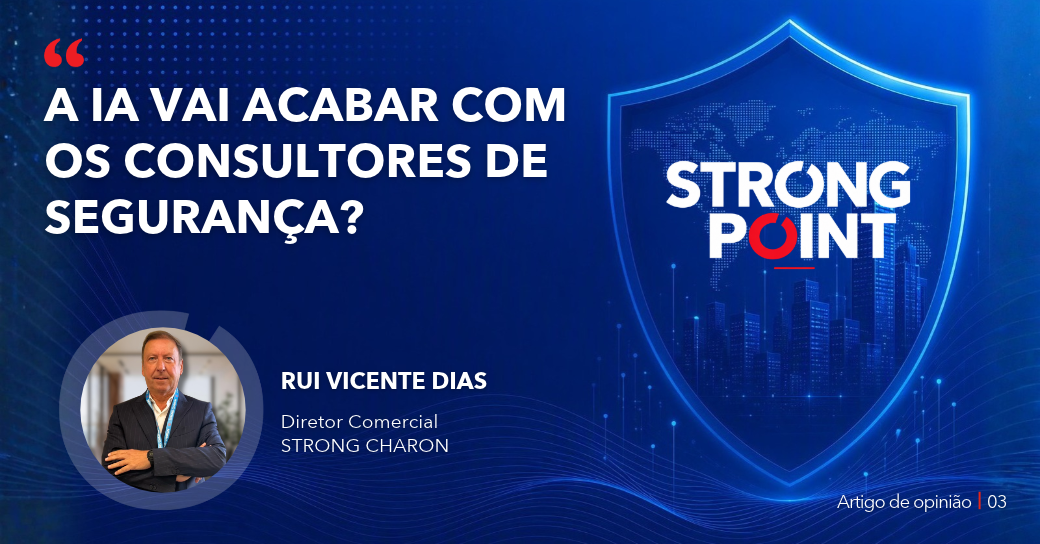
Why is it that the greatest risk for a consultant may be to continue working the way they always have?
There’s a question that’s starting to circulate in the security industry, usually accompanied by a nervous smile: Will artificial intelligence replace security consultants?
I have a rather undiplomatic answer: yes, it will replace some of them.
Especially those who continue to confuse consulting with fifty-page reports, colorful risk matrices, and recommendations so generic they could apply equally to securing a data center or a sausage factory. If the conclusion is invariably to install more cameras, more sensors, and more procedures, perhaps we’re not dealing with a consultant, but with a walking sales catalog. And its days are numbered.
The bad news: AI is already part of our work.
Let’s skip the talk about the extraordinary opportunity to leverage synergies and accelerate digital transformation. No one can stand it anymore.
AI cross-references incidents, identifies patterns, compares technologies, explores scenarios, supports audits, and prepares an initial report while the consultant is still choosing a font. It doesn’t ask for per diem, doesn’t complain about travel, and doesn’t need to book a hotel.
It’s true that he also makes things up with disconcerting confidence. But let’s be fair: we all know consultants who do exactly the same thing.
Bruce Schneier, one of the leading figures in security thought, has been emphasizing an idea that should be obvious but that we so often forget: “Security is a process, not a product.” The advent of AI does not change this principle; it makes it even more important. Because a bad strategy does not become a good one just because it has an algorithm. It can, however, be executed with impressive efficiency.
Security isn’t a race.
Imagine a logistics hub with dozens of loading docks, hundreds of workers, third-party carriers, and 24-hour operations. AI can cross-reference alarms, movements, and incident histories to identify vulnerabilities that would be missed by conventional analysis.
But who assesses the cost of a measure that delays shipping? Who realizes that a physical barrier can complicate an evacuation? Who manages the conflict between security, operations, the budget, and each department’s irresistible urge to protect its own turf?
AI can help with these calculations. But on its own, it doesn’t understand the organization’s culture, what really happens during the night shift, or the difference between the written procedure and the one everyone follows when no one is looking.
That’s where the Consultant adds value: not by knowing every camera model on the market, but by understanding the business, asking the tough questions, and, when necessary, telling the client that the solution they want to buy isn’t the solution they need.
AI doesn’t threaten those who think. It threatens those who have stopped doing so.
For years, mastering standards, manufacturers, and technical specifications was a competitive advantage. It remains relevant, but it is no longer enough. Information has become accessible; it is the ability to interpret it, question it, and turn it into decisions that sets a professional apart.
A Consultant who makes good use of AI can test more hypotheses, compare solutions, detect inconsistencies, and free up time to visit facilities, talk to teams, and understand the operation. A Consultant who blindly accepts a well-written answer is simply outsourcing the reasoning and rubber-stamping it.
In the Security sector, the appearance of rigor is not the same as actual rigor. A wrong recommendation can put people, operations, and critical infrastructure at risk. Experience, critical thinking, and responsibility are not optional extras in the premium package.
And there’s an elephant in the room: the price.
If AI allows us to complete an analysis in two hours that used to take two days, are we going to continue billing for two days just because the report has the same number of pages? Or are we finally going to start selling the value of the recommendations, rather than the time spent producing them?
AI will push consulting firms to separate three activities: gathering information, interpreting information, and taking responsibility for a decision. The first will become increasingly automated; the second, profoundly transformed; the third will continue to require people who know what they’re doing—and who take responsibility for their recommendations.
Customers, too, will have better tools to compare proposals and challenge assessments. Excellent—perhaps presentations that tout as an innovation a feature that’s been available on the market for five years will no longer be so impressive.
So, who’s staying?
I don’t believe AI will put an end to Security Consultants. It will, however, put an end to—or at least make life very difficult for—consulting firms that rely on repetition, information asymmetry, and cookie-cutter responses.
A good Consultant will use AI as an extension of their analytical abilities, not as a substitute for their judgment. They will know how to ask better questions, recognize dangerous answers, and advocate for recommendations that do not always align with what the client or the manufacturer would like to hear.
The key question is no longer “Can AI do my job?” but rather “If AI can do a significant part of my job, what value do I add?”
My belief is simple: AI won’t replace good Security Consultants. It will replace the Consultants who don’t know how to work with it.
If there’s one profession that can’t afford to be caught off guard, it’s that of a Security Consultant. Especially when the threat doesn’t come through the fence, but through the computer.
Rui Vicente Dias – Sales Director.